Practical logo guides by trade
Jewelry brand logo: monograms, engraving and gift boxes
A jewelry logo has to look elegant at full size on an online store, then hold up on a few millimeters: a clasp tag, the inside of a ring, the lid of a gift box. This guide helps you balance finesse and reproduction, and reminds you what a logo is not: a regulatory hallmark.
BrandMotion Lab · Published · 7 min read
Premium, designer or fashion: set the tone before drawing
Fine and premium jewelry
Spaced capitals, fine serifs, a monogram, a palette limited to black, one deep color or a metal. Restraint is part of the message; an overly decorative logo quickly looks dated.
Independent designer or craft studio
More personality: a handwritten signature, a shape inspired by a tool or material, a drawn symbol. Keep a simple version: the signature must stay legible once engraved.
Fashion and costume jewelry
Freer colors, contemporary type, a strong social media presence. The logo mostly appears on display cards, pouches and the online store.
Personalized or engraved jewelry
Customers have a name or a date engraved: your logo should not compete with the personalization. A small, discreet monogram on the back or on the packaging is enough.
Wordmark and monogram: the essential pair
Almost every jewelry brand works with two versions:
- The wordmark: the full name, for the online store, the gift box lid and the authenticity or care card.
- The monogram: one or two initials, for the clasp tag, the inside engraving, the seal sticker, the avatar and tissue paper.
A good monogram still reads at a very small size and in relief, without color. Avoid tight interlacing: what looks refined on screen turns into a blot once engraved on a few millimeters.
Fine lines: elegant on screen, fragile when small
- Very fine serifs and hairlines disappear in engraving, hot-foil stamping and printing on small items.
- The inner spaces of letters (o, e, a) fill in when strokes are too close together.
- A simplified version for small sizes is normal: slightly thicker strokes, fewer details, the same silhouette.
- The scale test: print the logo at the actual size of your smallest item and look at it from a normal reading distance.
Demo: two directions for the same house
These two concepts were generated by BrandMotion Lab’s engine for “Maison Dorée”, a fictional brand from the luxury sector of our demo gallery. It is neither a customer nor a jewelry brand: the comparison is about the design, against the constraints of engraving and small items.
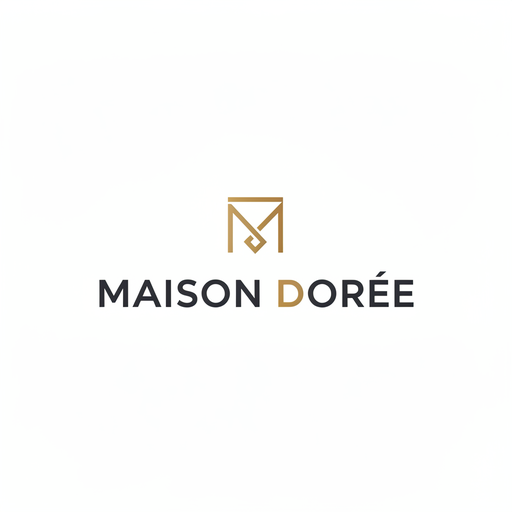
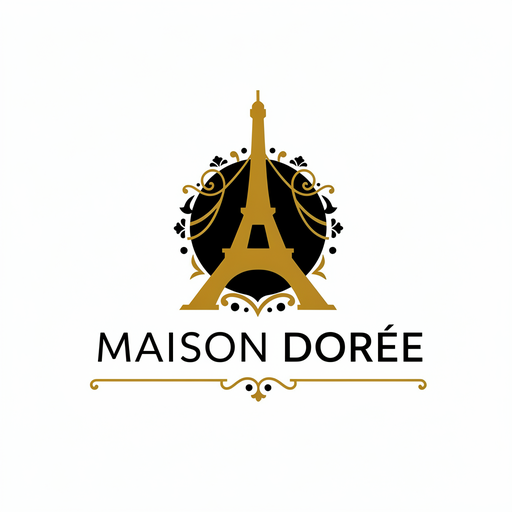
Engraving the logo on metal
Laser engraving, mechanical engraving or stamping: each process has its own limits in fineness, depth and surface. The same logo is not prepared the same way for the inside of a ring, a pendant or a clasp tag.
- Provide a vector file as the source: the engraver uses it to prepare the file for their machine (line weights, fills, order of passes).
- An SVG is not automatically ready to engrave: depending on the machine and software, outlines may need converting, shapes closing or strokes adjusting. That preparation belongs to the engraver.
- Ask for a test on an offcut of the same metal and finish before engraving a batch.
- Plan the one-color version: engraving only has “filled” and “empty”, with no gradients.
Brand logo and hallmarks: two different things
In France, for example, gold, silver and platinum articles fall under the precious metals guarantee system run by customs. According to its guidance, they carry a maker’s mark (a lozenge, for manufacturers) or a responsibility mark (an oval, for importers), which acts as the professional’s signature and commitment, plus a state guarantee hallmark. To be sold as gold, silver or platinum, a piece must reach a minimum fineness (375, 800 and 850 thousandths).
In France, gold or platinum pieces under 3 grams and silver pieces under 30 grams are exempt from the guarantee hallmark, but they must still meet the legal fineness and carry the maker’s or responsibility mark.
Your logo replaces none of these marks, and it should not imitate them (a lozenge or oval shape stamped like an official mark). This guide covers design, not regulation: hallmarking rules vary widely between countries, so check with the competent authority where you sell before marketing precious-metal jewelry. The French sources are listed at the bottom of the page.
Gift boxes, cards and packaging
- Gift box: hot-foil stamping and embossing need a one-color version with a clean drawing.
- Suede or fabric pouch: printing there is less precise than on paper; avoid thin lines.
- Authenticity or care card: often the only place where the full wordmark appears with your details.
- Seal or sticker: a natural place for the monogram.
- Gold color: on-screen gold becomes a metallic spot color or foil in print. Ask the printer how they reproduce it and keep a black fallback version.
The constraints of small packaging are close to those of cosmetics: the guide cosmetics brand logo covers them in detail.
Online store and product photos
Online, the jewelry must stay the hero: a restrained wordmark in the header, the monogram as favicon and avatar. Avoid placing a large watermark logo over product photos, which gets in the way of seeing the piece. The e-commerce logo page and the guide creating a Shopify logo cover the header, mobile view and favicon.
Common mistakes
- A diamond, ring or crown by default: these symbols are everywhere in the sector and rarely set you apart.
- A monogram made unreadable by interlacing.
- Lines too fine for engraving and foil.
- A logo that imitates an official hallmark or an existing luxury brand: a risk of confusion and dispute.
- Ordering boxes and cards before seeing a foil sample.
- Launching the brand without checking the name in trademark databases: see registering a logo with the INPI for France.
A simple method with BrandMotion Lab
- Define your tone (premium, designer, fashion, personalized) and the smallest item you need to mark.
- Test a direction with the no-account trial: two watermarked previews, limited, with no downloadable files.
- With an account, compare six free Logo Pack concepts; favor those you can derive a monogram from.
- Print the concept at the size of your clasp tag and gift box, in black only.
- After the one-time payment, send the SVG or PDF to your engraver and box maker, and ask for a test or a sample.
To check that an .svg file really contains paths rather than a pasted image, see 7 checks for a real SVG logo.
Frequently asked questions
- Can the logo be used as a maker’s mark?
- No. In France, the maker’s mark is a regulatory mark under the precious metals guarantee system, with its own rules on shape and registration. It is separate from your brand logo, even if both use your initials. Other countries have their own systems.
- Can the Logo Pack SVG be used directly for laser engraving?
- It is the right starting point: a file built from vector paths, sharp at any size. But every machine has its own settings: the engraver adapts the file (outlines, fills, line weights) and runs a test before the batch. The Logo Pack does not deliver a file prepared for a specific machine.
- Does the logo need to be gold?
- No. On-screen gold becomes foil or a metallic ink in print, which costs more. A logo that works in black and white remains essential; gold then becomes a finish, not a requirement.
- Which files will I get for the box and the store?
- With the Logo Pack: an SVG built from vector paths and a vector PDF for the printer and the engraver, PNGs for the online store, dark and light monochrome versions and a one-page brand guide. The files are RGB; preparing the foil is up to the printer.